Find it, build it, sell it: a $5,000 weekend with Claude + Maps + gpt-image-2 + Veo
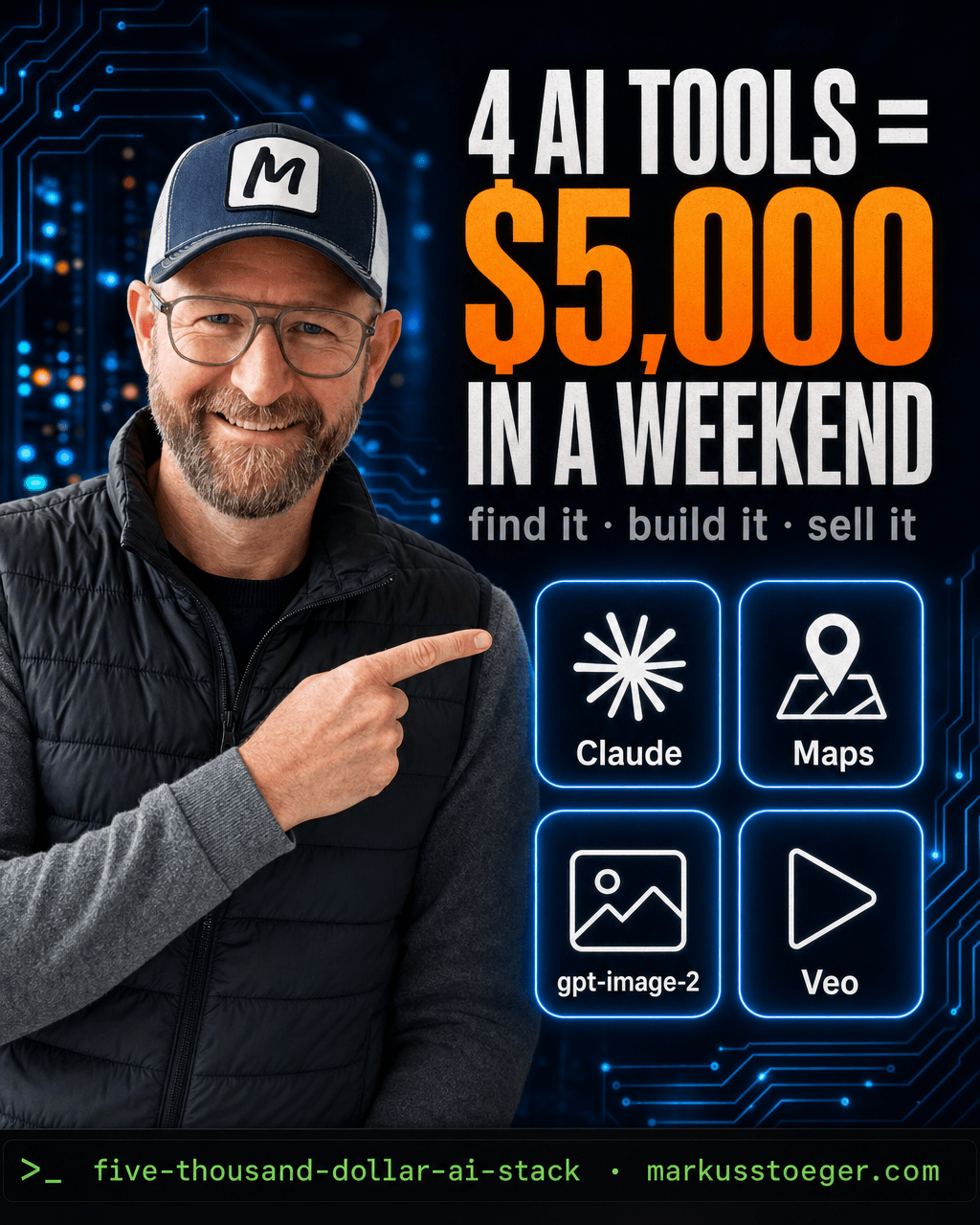
A local business (a restaurant, a gym, a dentist) happily pays around $5,000 for a proper website. The work itself was never the hard part. The hard part was being four people at once: the prospector who finds the client, the designer who makes it look expensive, the videographer who shoots the promo, and the copywriter who writes it. Do all four yourself the old way and it's two weeks.
Four AI tools and Claude as the conductor collapse that into one weekend. Find it Friday, build it Saturday, sell it Sunday. This is the exact play.
Friday: find the client (Google Maps)
Claude queries the Maps/Places API for a category in a town ("dentists in Linz") and pulls the ones with a weak web presence: no site, a broken one, or a dead Facebook page as their only home. Those are your prospects. It sorts them by rating and review volume so you go after the real businesses, not the dead ones, and hands you a shortlist with names and contacts.
Saturday: build it (Claude + gpt-image-2 + Veo)
- Claude + skills → the website. Give Claude the business and a skill for your stack (Next.js, Astro, whatever) and it builds the whole site: structure, copy in the owner's voice, responsive layout, contact form. A real site, not a template fill-in.
- gpt-image-2 → the visuals. From the same brief, Claude prompts gpt-image-2 for a hero image, section visuals and a clean logo direction: on-brand, with real text baked in. (Connecting gpt-image-2 to Claude is its own short tutorial.)
- Veo → the promo. Claude turns the strongest visual into a Veo prompt and generates a 10–15s promo clip for the hero section and the owner's social, the thing that makes a $500 site feel like a $5,000 one.
Sunday: sell it
You don't pitch a deck, you send a link. The site is already live on a preview URL with the owner's name on it. "I built your new website. Here it is. Want it?" Seeing their own business look premium is the close. Collect, point the domain, hand it over. One weekend, one deliverable, one invoice.
How to wire it
Claude is the conductor; each tool is a connector it can call:
Tools available to Claude:
  maps_search(query)        → Places API: find businesses + weak web presence
  generate_image(prompt)    → gpt-image-2: hero, sections, logo
  generate_video(prompt)    → Veo: the promo clip
  + a build skill           → your stack (Next.js/Astro), deployed to a preview URL
- Expose each API as an MCP tool (or a typed function the agent can call), and add a skill that encodes how you build and deploy a site.
- Give Claude the goal ("find weak-website dentists in [town], build a site for the best one, deploy it to a preview URL") and the tools.
- Claude runs the sequence: prospect → build → visuals → promo → deploy. You review at each handoff, then do the human part: send the link and close.
Why it matters
The $5,000 was never for the pixels. It was for doing four jobs without dropping the thread. That coordination is exactly what an AI conductor does for free. The tools are the cheap part now; the edge is being the one operator who can run all four and still be the human who knocks on the door. Same price tag to the client, built in a weekend, and the whole margin is yours.
From the author
These tutorials come out of the work itself, not out of research: I put AI to work in real companies and write down what holds up. If you want to know which of your processes are worth it, I offer AI consulting for small and mid-sized companies. If you already know what to build, I handle the AI integration into your systems.
Built with AI – the newsletter
Hands-on AI tutorials and the tools I actually use, straight to your inbox. Free, no hype.
Powered by Substack. Unsubscribe anytime.