Validate your business idea by starting one year in the future
Ask Claude "is my business idea good?" and it will find something nice to say. That agreeableness is comfortable, and it's exactly why founders waste a year building the wrong thing. The fix is a better frame, not a better model.
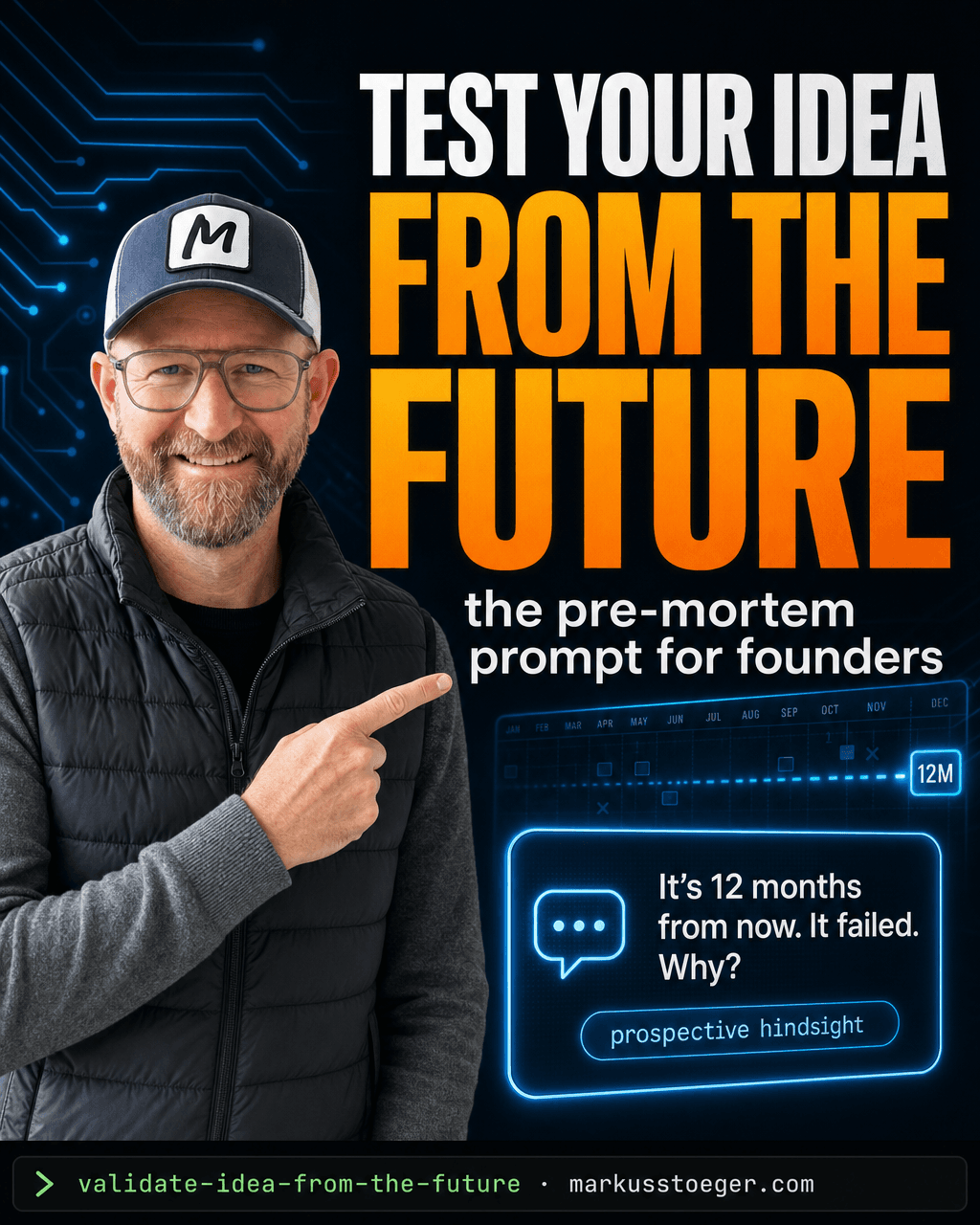
Don't ask Claude to predict whether your idea works. Tell it the idea already failed, then ask it why. Standing one year in the future, looking back at the wreckage, Claude stops flattering and starts diagnosing.
The trick: start from failure
This is the pre-mortem, and psychologists have a name for why it works: prospective hindsight. People are far better at explaining a known outcome than predicting an unknown one. "Why did it fail?" pulls out concrete, specific reasons that "will it work?" never does.
So you hand Claude the outcome (failure) and let it reverse-engineer the causes. The result reads like a brutal advisor's memo instead of a cheerleader's pep talk.
The three prompts
Run them in order, in one chat, so Claude keeps the context.
1. The pre-mortem:
It's 12 months from now. I launched [idea] and it failed.
Write the brutal post-mortem: the 5 most likely reasons it died,
ranked by probability. Be specific, not generic. No reassurance.
2. The steelman against you:
Now argue the strongest possible case AGAINST this idea ever working.
Attack the core assumption, the market, and the unit economics.
Assume I'm too close to see the flaws.
3. The skeptical customer:
Role-play my exact target customer: [describe them].
I pitch you the product. Push back on anything that doesn't ring
true, the way a real busy person would. Don't be polite.
Read it like an investor
Each answer is a list of risks. Turn them into a kill-list: for every reason Claude named, write the one cheap test that would prove or disprove it this week: a landing page, ten cold DMs, one pre-sale. You're not trying to feel good about the idea; you're trying to find the cheapest way to be wrong before it costs you a year.
If three rounds of Claude attacking your idea can't kill it, that's a real signal. If the first prompt does: congratulations, you just saved twelve months.
Why it matters
Most "AI for founders" advice makes the agreeableness problem worse: it generates business plans, names, and taglines that all sound plausible because the model wants to please you. Plausible is the enemy. The future-failure frame flips Claude from a yes-machine into the brutally honest advisor every founder needs and almost never has, for free, before you've written a line of code or spent a euro.
From the author
These tutorials come out of the work itself, not out of research: I put AI to work in real companies and write down what holds up. If you want to know which of your processes are worth it, I offer AI consulting for small and mid-sized companies. If you already know what to build, I handle the AI integration into your systems.
Built with AI – the newsletter
Hands-on AI tutorials and the tools I actually use, straight to your inbox. Free, no hype.
Powered by Substack. Unsubscribe anytime.